
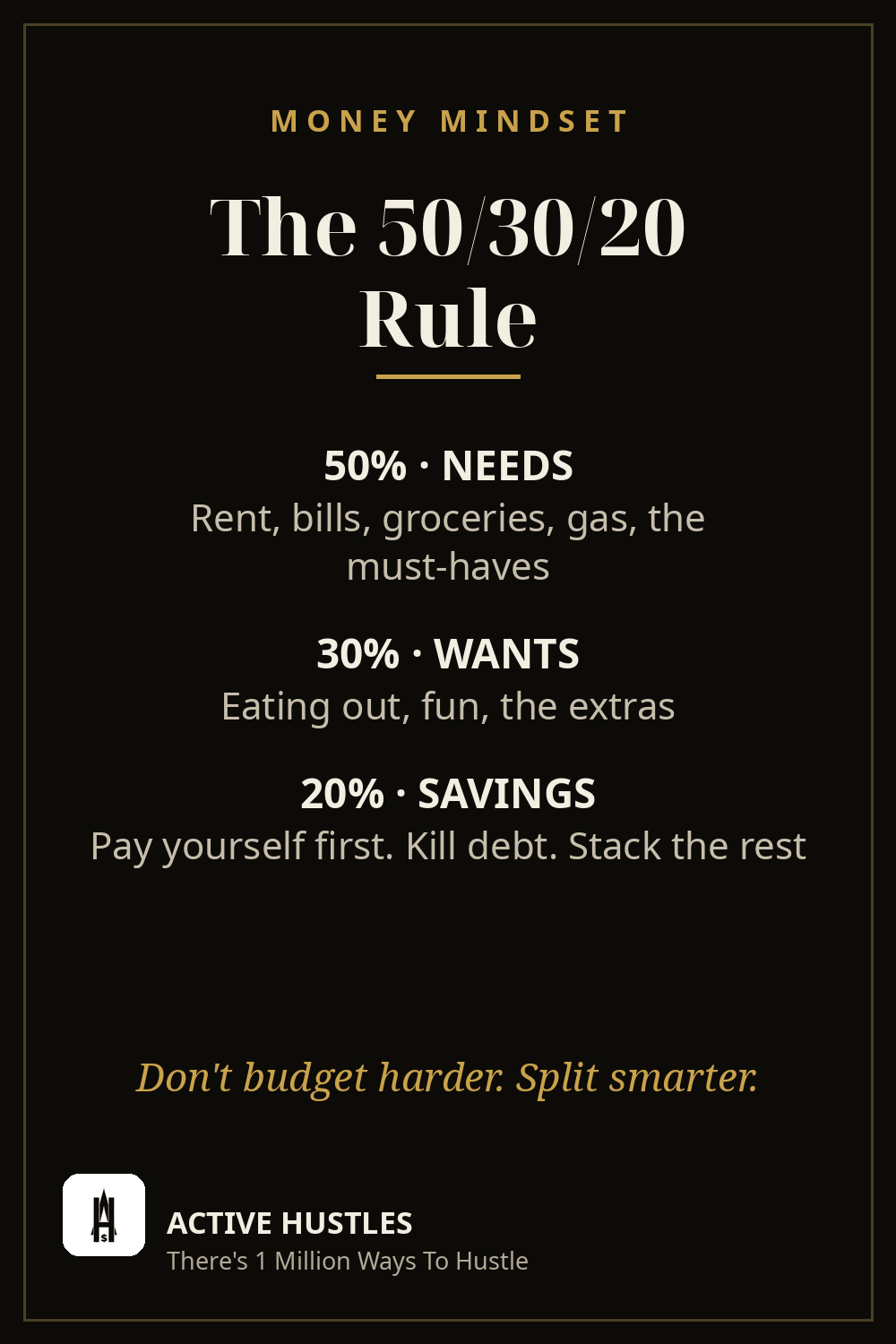
Budgeting does not have to be complicated. Most budgets fail because they try to control fifty categories at once. The 50/30/20 rule controls three.
The split
- 50% to needs: rent, groceries, utilities, minimum payments, the bills that keep life running.
- 30% to wants: eating out, streaming, trips, the fun that makes the budget worth keeping.
- 20% to savings and debt payoff: the cushion, the investments, and killing balances above the minimums.
Run it on take home pay, not salary. If your needs sit above 50% right now, that is information, not failure: it tells you exactly which big bill to attack next. Small months count too. A 60/25/15 month that actually happens beats a perfect split you quit in February.
Pay yourself first and let the system do the work. Automate the 20% on payday and the rest of the budget gets much easier to keep.
Case study
Case study: Kyle Taylor, The Penny Hoarder
In our own words. Original story linked below.
- Who
- Kyle Taylor, founder and CEO of The Penny Hoarder, a personal finance media company.
- Starting point
- According to the So Money episode summary, Taylor was saddled with $50,000 in student loan and credit card debt in 2010, and began blogging about becoming debt free.
- First moves
- Documented his money journey publicly and built The Penny Hoarder from a personal blog into a larger media business.
- Adopted simple percentage based budgeting as a way to think about money.
- What worked
- In a St Pete Catalyst profile, Taylor said he is a big fan of the 50/30/20 budget, describing it as 50 percent toward fixed expenses, 30 percent for discretionary spending, and 20 percent into saving for the future. The So Money summary reports that the blog grew to $20 million in revenue in six years.
- What to copy
- Use three buckets instead of tracking every small category. Decide the fixed, fun, and future split before spending, and let the 20 percent future bucket be non negotiable.
- Watch out
- Outlier flag, stated explicitly. Going from $50,000 in debt to a $20 million revenue media company is an extreme outlier, not a typical result of a budget split. The sources do not prove that 50/30/20 alone caused that business growth. Use Taylor as a real endorser of the rule, not as proof that the rule alone builds a large company. Also, the St Pete profile endorses the rule but does not give a detailed month by month household budget for Taylor.
- Source
- St Pete Catalyst, Kyle Taylor - St Pete Catalyst
Corroborating: So Money with Farnoosh Torabi, 520: Kyle Taylor, Creator of ThePennyHoarder.com
Takeaway: Three buckets, one payday routine, zero spreadsheet headaches.